
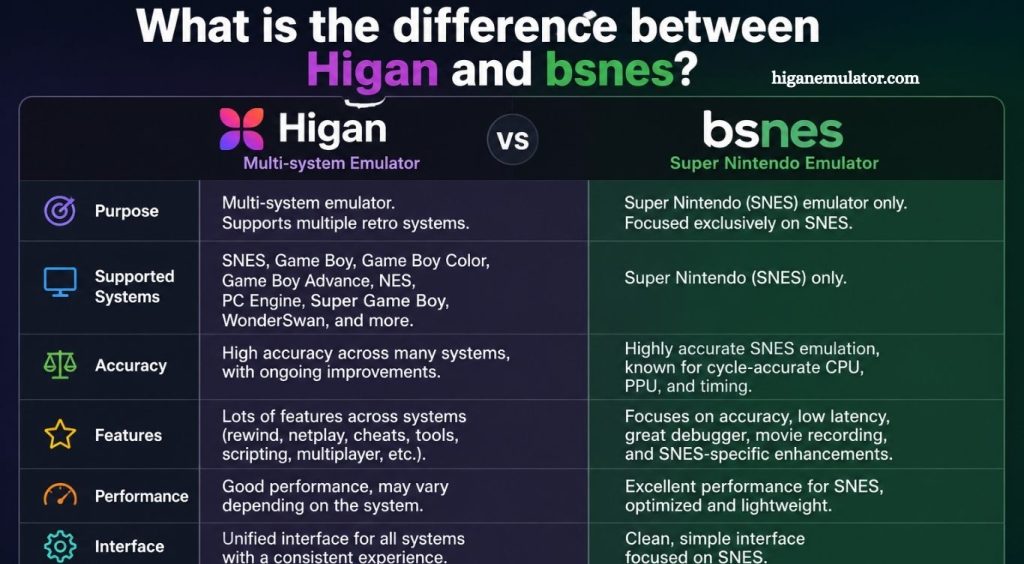
The world of retro gaming emulation has evolved significantly over the years, offering players the ability to experience classic console titles on modern hardware. Among the most respected names in Super Nintendo emulation are bsnes and Higan, both known for their focus on accuracy and preservation rather than casual performance gains.
Although many users often confuse these two projects or assume they are completely separate, they are closely related in development history. Understanding their differences is important for anyone interested in high-fidelity emulation, retro game preservation, or simply choosing the right emulator for an optimal experience.
Overview of bsnes
bsnes is widely recognized as one of the most accurate Super Nintendo Entertainment System emulators ever created. Its core design philosophy focuses on cycle-accurate emulation, meaning it replicates the original hardware behavior as closely as possible. This makes it especially valuable for developers, preservationists, and players who want an authentic experience without glitches or timing issues.
Read More: What operating systems support Higan?
Over time, bsnes evolved to support different performance profiles, allowing users to balance accuracy with system requirements. Even so, its main identity remains rooted in precision rather than speed, making it a benchmark in SNES emulation quality.
Overview of Higan
Higan began as a continuation and expansion of bsnes, developed to go beyond a single console system. While bsnes concentrated solely on SNES emulation, Higan was designed as a multi-system emulator capable of running multiple classic consoles under a unified framework.
The design approach of Higan emphasizes a “library” structure where each game is treated as a self-contained package. This structure improves organization and preserves original data integrity, but it also makes setup more complex compared to traditional emulators.
Key Differences Between Higan and bsnes
The primary difference between bsnes and Higan lies in their scope and design philosophy. bsnes remains focused exclusively on Super Nintendo emulation, optimizing deeply for accuracy within that single system. Higan, on the other hand, expands beyond SNES to support multiple systems under one architecture.
Another important distinction is usability. bsnes tends to be more straightforward for users who simply want to play SNES games with high accuracy. Higan introduces a more structured and preservation-oriented workflow, which can feel heavier for casual gaming but more powerful for archival purposes.
Their development paths also differ over time, as bsnes continues to exist as a specialized emulator while Higan represents a broader evolution of the original project into a multi-system environment.
Performance and Accuracy Considerations
Both emulators prioritize accuracy over raw performance, but bsnes offers more flexibility in choosing performance profiles depending on hardware capability. This makes it slightly more adaptable for users with mid-range systems.
Higan, due to its broader scope and stricter structure, can demand more system resources and setup effort. However, it provides a highly consistent emulation environment once properly configured, especially for users managing multiple retro systems in one place.
Which One Should You Choose
Choosing between bsnes and Higan depends on user goals. If the focus is purely on Super Nintendo gaming with minimal configuration and high accuracy, bsnes is the more direct option. If the goal includes multi-system emulation with a strong emphasis on preservation and organization, Higan becomes more suitable.
Both emulators share a common legacy, and neither is objectively superior in all scenarios. Instead, they serve different types of users within the retro gaming community.
Frequently Asked Questions
Is bsnes the same as Higan
bsnes and Higan are closely related, but not the same. bsnes focuses only on Super Nintendo emulation, while Higan expands into a multi-system emulator built on the same accuracy-focused foundation.
Which emulator is more accurate, bsnes or Higan
Both bsnes and Higan aim for high accuracy. bsnes is highly optimized for SNES accuracy, while Higan maintains accuracy across multiple systems with a preservation-first approach.
Why was Higan created from bsnes
Higan was created to extend bsnes beyond a single console. The goal was to build a unified emulator that could handle multiple retro systems with consistent accuracy and structure.
Is bsnes easier to use than Higan?
Yes, bsnes is generally easier for beginners because it is focused only on SNES games. Higan has a more complex setup due to its multi-system library-based design.
Does Higan replace bsnes
Not exactly. Higan evolved from bsnes, but bsnes still exists as a dedicated SNES emulator, while Higan serves a broader multi-system purpose.
Which one is better for low-end PCs
bsnes is usually better for low-end systems because it offers performance profiles and is less resource-heavy compared to Higan’s broader architecture.
Can both emulators run SNES games perfectly?
Yes, both bsnes and Higan can run SNES games with high accuracy, but bsnes is often preferred for a simpler and more direct SNES gaming experience.
Conclusion
bsnes and Higan share a common origin, yet they serve different needs within the emulation community. bsnes remains a specialized Super Nintendo emulator built for precision, simplicity, and focused performance. Higan expands that foundation into a broader multi-system platform designed with a strong emphasis on preservation and structured game management.